
How Walmart Marketplace Management Services Can Boost Your Online Sales
Selling products online through Walmart can give businesses access to...

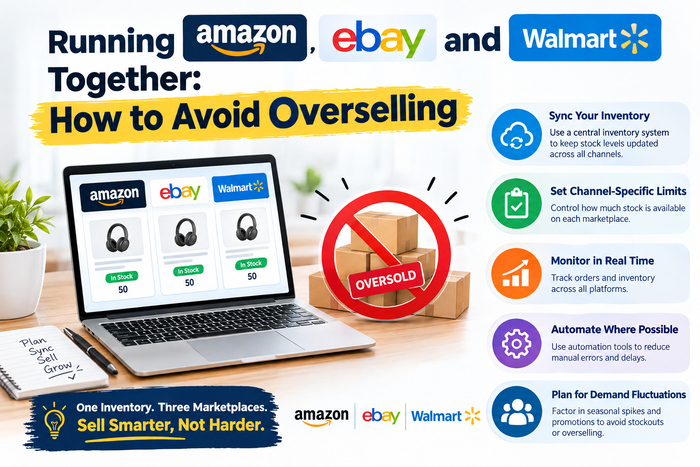
Picture this. You have 12 units of a bestselling item left. A customer on Amazon buys 3. Someone on eBay grabs 5. Walmart gets 4 in the same hour. Then a fourth order lands on one of them, and you’re standing in the warehouse with nothing to ship.
Now you’ve got a cancelled order, an annoyed customer, and a mark against your seller metrics on a platform that takes those marks seriously. Overselling is one of the most common problems for anyone selling on Amazon, eBay and Walmart at the same time, and it’s also one of the most fixable.
This guide explains why it happens, what it costs you on each marketplace, and the habits that stop it.
Quick Answer
Why Overselling Happens When You Sell on Three Marketplaces
Most overselling comes down to a handful of causes.
1. Sync lag. A sale on one channel takes time to reduce stock on the others. If two orders arrive inside that gap, you’ve sold the same unit twice.
2. Manual updates. If someone updates stock in spreadsheets or in each seller dashboard by hand, mistakes are only a matter of time. It works at 20 SKUs. It falls apart at 2,000.
3. Separate stock pools that don’t match reality. Some sellers hold stock back “just for Amazon” and “just for eBay.” That feels safe, but you end up with one channel sold out while another sits on spare units, and counts drift out of line.
4. Untracked movements. Returns, damaged units, samples, warehouse mis-picks and stock sold in a physical shop often never reach the system.
5. Messy catalogue data. Inconsistent SKUs, duplicate listings and badly mapped variations mean a sale on one channel reduces the wrong item, or none at all.
6. Spikes. Promotions and peak seasons send several orders at once, and every weakness above gets exposed.
What Overselling Costs You on Each Marketplace
Cancelling an order you can’t fulfil isn’t free. Each marketplace tracks it. The targets below are the commonly cited ones at the time of writing. Platforms change their standards, so check your own dashboards for the current figures.
A few things stand out. First, 2% isn’t much. If you ship 500 orders and cancel 10 because you ran out of stock, you’re already at the limit. Second, the damage isn’t only the metric. You also lose the sale, pay in refunds or fees, and give a buyer a bad first impression. Third, one oversold SKU on one channel can quickly push the whole account toward warnings or restrictions.
One more nuance: orders that Walmart itself fulfils aren’t measured against these seller-fulfilment metrics. That doesn’t mean you can stop managing stock, because you can still run out of units that you’ve also listed elsewhere.
How to Stop Overselling: A Practical Step-by-Step Plan
1. Create one source of truth for stock
Pick one place where your real stock count lives. That might be an inventory management tool, an ERP or a well-run central sheet for a small catalogue. Every marketplace should read from that number, not keep its own.
If you split stock between channels, do it deliberately, with clear rules, and review it often. Don’t do it by accident.
2. Sync automatically, and find out how often it really syncs
Manual updating doesn’t scale. Use a tool or connector that pushes stock changes to all three marketplaces automatically.
Then test it. Ask the vendor how fast updates really happen, and check it yourself by changing a quantity and timing how long each channel takes to catch up. “Real-time” means different things to different tools, and a ten-minute delay on a fast-moving SKU can be plenty of time to oversell.
3. Publish “available” stock, not “on hand”
What you have on a shelf isn’t what you can safely sell. A simple formula:
Available to sell = on-hand − reserved or being picked − damaged or quarantined − safety buffer
For example (made-up numbers): 40 on hand, 3 reserved for orders being picked, 2 damaged and a buffer of 4. You’d publish 31, not 40.
4. Hold back a safety buffer, and tune it
A buffer protects you from sync lag and counting errors. Some vendors suggest holding back around 5% to 10% of stock as a rule of thumb. Treat that as a starting point, not a law.
Use a bigger buffer for fast-moving SKUs, for the channel that syncs slowest, and during promotions. Use a smaller one, or none, for slow sellers where oversell risk is low. Setting a buffer on every SKU the same way wastes sales on the items that don’t need it.
5. Clean up your catalogue data
Syncing only works if SKUs match across channels. Before you automate, check that every product has one consistent SKU, variations are mapped properly, bundles and multipacks are set up so one sale reduces the right component stock, and duplicate or dead listings are removed.
This is dull work, and it’s where a lot of overselling really starts. A clean catalogue also makes it easier to run inventory and order processing across channels without surprises.
6. Match handling times and order import to reality
If your system only imports orders every few hours, but your listings promise next-day dispatch, you’re setting yourself up for trouble. Make sure your handling times, cut-off times and order-import frequency reflect what your warehouse can really do.
7. Build a simple daily and weekly routine
Software doesn’t replace attention. Here’s a routine that works for most sellers:
8. Plan ahead for promotions and peak seasons
Sales events are when oversells happen most. Before a big promotion, raise your buffers on promoted SKUs, limit the quantity per customer if the channel allows it, make sure replenishment is on the way, and decide in advance which listings you’ll pause if stock gets low.
9. Have a plan for when it still happens
Even with good habits, an oversell will eventually slip through. Don’t ignore it and hope. Pause the affected listings straight away, and contact the buyer where you can. Cancel through the marketplace’s own process as soon as you know you can’t deliver, because slow, silent failures make things worse. Then find the cause and fix it, so the same SKU doesn’t do it again next week.
A Note on Marketplace Fulfilment
Using Amazon FBA, Walmart Fulfillment Services or similar can take pressure off, but it doesn’t remove the problem. If the same stock is also listed on another channel, or you move units between warehouses, your counts can still drift. Also check each marketplace’s rules before you fulfil an order from one channel using stock held at another, because policies on this vary.
Tools or People?
You’ll need both. Inventory software can sync quantities faster than anyone can by hand. But it only works with the data you give it, and it can’t spot a mis-mapped SKU or a damaged pallet nobody logged.
A good setup is software for the heavy lifting plus a person, in-house or outsourced, who watches the exceptions every day. When one team already looks after your listings, stock and orders across all three marketplaces, problems tend to get caught earlier because nothing falls between channels.
Overselling Prevention Checklist
Before you call your setup safe, tick off each of these:
When to Get Outside Help
Consider help if you’re selling the same SKUs on three or more channels, your catalogue is large and messy, you’ve already had cancellation warnings, your team spends hours each day correcting stock, or you’re about to add another marketplace.
Frequently Asked Questions
Q1. What is overselling in ecommerce?
Overselling is when you accept more orders than you have stock to fill. It’s most common when you sell the same products on several channels and the stock counts don’t update fast enough.
Q2. How do I avoid overselling on Amazon, eBay and Walmart?
Keep one master stock count, sync it automatically to all channels, publish available stock instead of on-hand stock, hold a safety buffer on fast-moving SKUs, and check exceptions daily.
Q3. How big should my safety stock buffer be?
There’s no single right number. Some vendors suggest 5% to 10% as a starting point. Use larger buffers for fast sellers, slow-syncing channels and promotions, and smaller ones for slow movers.
Q4. Do I need inventory management software?
For a very small catalogue you might manage with a careful spreadsheet. Once you sell across three marketplaces with hundreds of SKUs, automated sync is realistic and worth having.
Q5. What happens if I cancel orders because I oversold?
Cancellations count against your seller metrics on all three marketplaces. Commonly cited targets sit around 2% to 2.5%, though thresholds can change, so check your dashboards. Repeated problems can lead to warnings or restrictions.
Q6. Does using FBA or Walmart Fulfillment Services prevent overselling?
It helps with fulfilment, and Walmart measures its own fulfilled orders differently. But if the same stock is listed on other channels, or you move units between locations, counts can still go wrong.
Q7. Should I split my stock between channels?
You can, but only with clear rules. A single shared count with a buffer is usually more efficient, since splitting can leave one channel sold out while another has spare stock.
Q8. How often should I count inventory?
Count your top sellers weekly, and update stock for returns and damages the same day. Run a fuller count on a schedule that suits your volume.
Conclusion
Overselling feels like bad luck, but it’s usually the predictable result of stock numbers that don’t agree. Keep one source of truth, sync automatically, publish what’s really available, hold a sensible buffer, keep your catalogue clean, and look at exceptions every day. Do that, and running Amazon, eBay and Walmart together gets a lot less stressful.
If you’d like help keeping listings, stock and orders in line across marketplaces, the team at Magic Infomedia can look at your setup with you. Take a look at our Amazon, eBay and Walmart management services, or get in touch with your channels, catalogue size and current stock tool.
Selling products online through Walmart can give businesses access to...
Protect your Amazon business with professional Amazon Account Health Management...

Selling successfully on Amazon requires more than simply uploading product...

Selling on eBay can open the door to millions of...

If your Amazon sales have plateaued — or worse, started...
Running an Amazon store sounds simple until you're actually doing...

You can have a great product, a fair price and...
Picture this. You have 12 units of a bestselling item...

Have you had any issues with Tax on Trade/ Sales...

A DRAT lawyer in Ghaziabad represents borrowers, guarantors, or banks...

On Jour erbjuder professionella Låssmedstjänster i Botkyrka för privatpersoner och...

Civil Appeals & Revision Remedies against Judgments, Decrees, Orders When...